Cargo news
What does modern air cargo terminal design look like?
Updated on 26 November 2025
A cornerstone of Finnair’s environmental strategy is that sustainability is considered in all the airline's procurement, logistics, planning and operations. Finnair's sophisticated new COOL Nordic Cargo Hub at Helsinki airport, opened in late 2017, is the very definition of modern air cargo terminal design. It considers environmental sustainability in air cargo operations in addition to customer and employee experience.
What is green air cargo terminal design?
- Terminal construction and design in line with BREEAM environmental standards
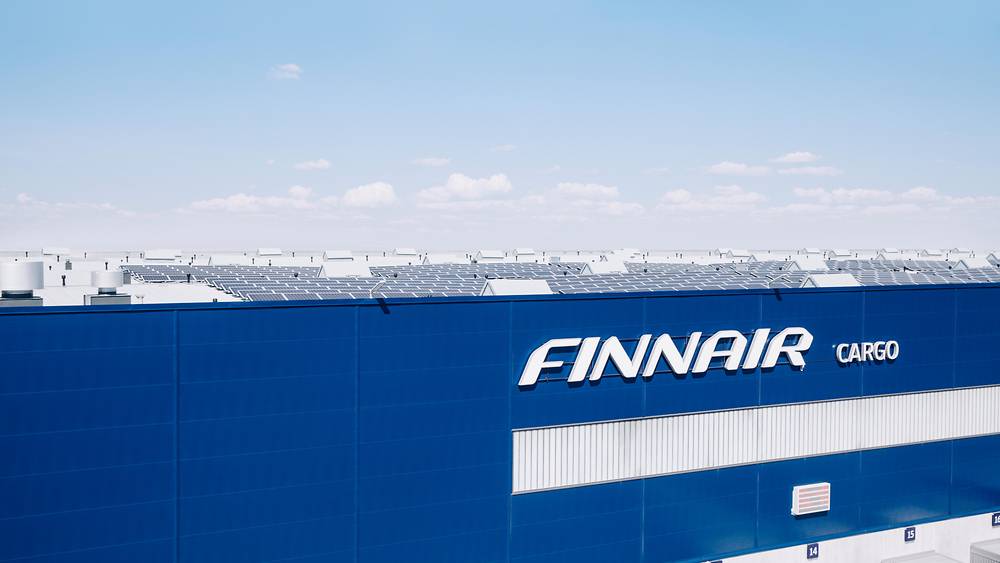
- 1,200 solar panels to provide 10% of the terminal's energy – upgraded to 2,990 panels providing up to 37% of the terminal’s annual consumption – read more: Upgraded solar plant powers Finnair’s cargo terminal | Finnair Cargo
- Automated ULD/container storage area does not require lighting to function
- COOL terminal is located next to wide-body aircraft stands to reduce transport time
- Truck management system alleviates unnecessary journeys and vehicle idling
- Maintenance and waste management schedules are optimised to cut down visits
- Automation directs COOL terminal forklifts to nearest task
- Warehouse automation assigns incoming goods to nearest available storage location
- Dedicated and separated areas for general cargo and temperature-sensitive goods
Since its inception, the environmental impact of the new COOL terminal has been taken into account at every step: in the planning and construction of the building; the energy supply; the proximity to wide-body Airbus aircraft stands; and even how energy-efficient operations are inside the terminal.
“The new 'COOL terminal' is part of Finnair Group’s sustainable development plan,” explains Milla Nyholm, who manages marketing and sustainability for Finnair Cargo.
“COOL supports the Group’s overall environmental goals, and so too does the acquisition of modern Airbus A350s to the fleet.”
Sustainability considered from the earliest stage
Already at the earliest design stage, planners of the terminal adopted the BREEAM (Building Research Establishment Environmental Assessment Method) process, an internationally recognised certification that evaluates all stages of building design and construction against widely recognised performance benchmarks.
“The building itself was constructed along sustainable construction lines,” Nyholm points out.
“For example, some 1,200 solar panels were installed to complement the terminal’s energy supply, representing over 10 per cent of the facility’s annual energy consumption. Each panel produces 260 watts of energy and the annual energy production level is estimated at 265 MWh/a." In celebration of Finnair’s centenary in 2023, a project was launched to expand the solar park on the roof of the terminal. Read more about the upgrade: Upgraded solar plant powers Finnair’s cargo terminal | Finnair Cargo
Similarly, the location of the terminal and supporting traffic engineering were purposely designed to optimise operations and reduce energy consumption. The terminal’s proximity to wide-body aircraft berths shortens tarmac transport distances, and a new truck yard management model reduces unneeded driving and idle running of vehicles. Maintenance and waste management schedules were also planned to ensure functional and sustainable operations at the terminal.
Optimised operations inside COOL
Inside the COOL terminal, operations and infrastructure were also planned taking into account how to minimise the environmental impact.
“An automated guidance system directs each forklift in the terminal to tasks nearest to its location, thereby reducing driving and lowering energy consumption,” says Nyholm.
“And based on the view of the Finnair network, our new Cargo Control Center (CCC) intelligently coordinates the work of the entire hub, with warehouse automation systems optimising the flow of goods and assigning the optimised storage location to each shipment entering the AS/RS (Automated Sending/Retrieval System).”
"To further boost energy efficiency, the automated ULD (Unit Load Device) storage area was designed to require no lighting to function.”
Sustainability across Helsinki Vantaa Airport
Already, there are clear signs that the efforts to achieve one of the world’s most modern cargo terminals are paying off.
The entity administering the BREEAM sustainability assessment process awarded the facility with a ‘Very Good’ rating, while the Helsinki Airport has been awarded the coveted Airport Carbon Accreditation (ACA) certificate for being a carbon-neutral airport.
“We are excited that our COOL Cargo Hub starts its initial operations, knowing that it has been achieved in accordance with the Finnair Group’s sustainability principles,” says Milla.